
BKPM, formally known as the Badan Koordinasi Penanaman Modal, is Indonesia’s Investment Coordinating Board and the central government body overseeing all foreign direct investment (FDI) in the country. Since 2021, BKPM has been elevated to a full cabinet ministry, now called the Ministry of Investment and Downstream Industry (Kementerian Investasi dan Hilirisasi). The 2025 rules matter too: BKPM Regulation No. 5 of 2025 cut the minimum paid-up capital for a PT PMA from IDR 10 billion to IDR 2.5 billion, introduced a 12-month lock on that capital, and tightened requirements around KBLI code planning. If you are researching Indonesia as an investment destination or planning to set up a foreign-owned company here, this updated guide covers the structure, the 2025 and 2026 requirements, and what they mean in practice.
Also Read: Complete Guide to Foreign Direct Investment (FDI) in Indonesia
What is BKPM in Indonesia?
BKPM (Badan Koordinasi Penanaman Modal) is Indonesia’s government authority for investment policy, licensing, and compliance monitoring. Established in 1973, it originally operated as a non-ministerial coordinating body tasked with attracting and facilitating both domestic and foreign investment.
In April 2021, the Indonesian government elevated BKPM to a full cabinet ministry through a presidential decree. Investment policy got a direct seat at the cabinet table, part of a broader regulatory overhaul under the Omnibus Law (Law No. 11 of 2020 on Job Creation). The new ministry was initially called the Ministry of Investment (Kementerian Investasi).
When President Prabowo Subianto’s government took office in October 2024, the ministry was renamed to Kementerian Investasi dan Hilirisasi, or Ministry of Investment and Downstream Industry. The change reflects the administration’s focus on downstream industrial processing as an economic driver. BKPM’s acronym, institutional structure, and bkpm.go.id website all remain the same.
Who Leads BKPM in 2026?
Rosan Perkasa Roeslani is the current Minister of Investment and Head of BKPM. He took over in August 2024 under President Jokowi, replacing Bahlil Lahadalia, who moved to Energy and Mineral Resources. Rosan continued under President Prabowo and was also appointed CEO of Danantara Indonesia, the country’s sovereign wealth fund, in February 2025.
In January 2026, Rosan reported that Indonesia’s investment realization throughout 2025 reached IDR 1,931.2 trillion. That figure is 101.3 percent of the government’s target and represents 12.7 percent year-on-year growth.
BKPM’s Commitment to Investment Climate

BKPM is on a mission to enhance Indonesia’s appeal as an investment destination. Over the years, it has undertaken several strategic initiatives aimed at improving the investment environment:
- Streamlining Approval Processes: BKPM has worked diligently to streamline the often complex investment approval process, making it more efficient for investors.
- Reducing Permit Requirements: To encourage investments, BKPM has reduced the number of permits and licenses required, cutting through bureaucratic red tape.
- Improving the Investment Environment: Through various reforms and measures, BKPM has taken steps to create a more favorable investment environment.
The efforts of BKPM have yielded remarkable results, as evidenced by the record-breaking $310 billion in foreign direct investment that Indonesia received in 2022.
Also read: Where to Invest in Indonesia: 7 Best Cities and Locations
BKPM’s Core Functions for Foreign Investors
Four areas of BKPM’s work directly shape what foreign investors must do in Indonesia.
Investment Policy and Regulation
BKPM drafts and enforces investment regulations, covering capital requirements, sector ownership caps, and licensing procedures. When additional technical licenses are required, it coordinates with sector-specific ministries such as the Ministry of Trade, Ministry of Health, or Ministry of Industry.
OSS-RBA Licensing Administration
All business registrations in Indonesia, from obtaining a Nomor Induk Berusaha (NIB) to securing operational licenses, go through BKPM’s Online Single Submission Risk-Based Approach (OSS-RBA) platform. InvestinAsia’s guide to the OSS system in Indonesia explains how the platform works for foreign companies.
Investment Realization Monitoring
Through the mandatory LKPM (Laporan Kegiatan Penanaman Modal, or Investment Activity Report) system, BKPM monitors whether companies are actually deploying the capital they declared at incorporation. Non-reporting can trigger automatic administrative sanctions through OSS.
Investment Incentive Coordination
BKPM coordinates fiscal incentives for investors in priority sectors: tax holidays, tax allowances, and import duty exemptions. These are not automatic. Each requires an application reviewed by BKPM and, in most cases, the relevant technical ministry.
Also read: 10 Reasons Why You Should Invest in Indonesia
Services Provided by BKPM
For investors looking to explore opportunities in Indonesia, BKPM offers an array of services:
Investment Counseling
BKPM provides expert advice and counseling to help investors make informed decisions.
Permit Assistance
It assists investors in obtaining the necessary permits and licenses, cutting through bureaucratic hurdles.
Information Hub
BKPM serves as a valuable source of information on investment opportunities in Indonesia.
Matchmaking Services
To facilitate business partnerships, BKPM offers matchmaking services to connect investors with potential business partners.
Also read: What to Invest in Indonesia: 7 Best Sectors for Foreigner
BKPM Guide for Foreign Direct Investment in Indonesia

Navigating the regulatory landscape for foreign direct investment (FDI) in Indonesia can be complex. BKPM has issued various regulations and guidelines to simplify the process and make it more investor-friendly. Here’s a brief overview of some key aspects:
Negative Investment List (DNI)
The DNI or Negative Investment List is a critical component of FDI regulation in Indonesia. It lists business sectors that are either closed to foreign investment or subject to specific restrictions. It is crucial for investors to stay updated on DNI changes, which are periodically revised by the government.
Business License
Irrespective of the nature of the business, all entities operating in Indonesia, including FDI companies, are required to obtain a business license. The process has been made more accessible through BKPM’s Online Single Submission (OSS) system.
For a simpler registration process, you can also check our services for Indonesia Business License Application.
Chat with us for FREE consultation about Indonesian Business Licenses
Principle License
The Principle License, while non-binding, signifies the government’s support for a particular FDI project. It expedites the approval process and offers certain investment incentives.
Sector-Specific Permits and Licenses
Depending on the industry, some businesses may need additional permits from other government bodies. For instance, companies involved in mining or energy may require permits from the Ministry of Energy and Mineral Resources.
For a simpler registration process, you can also check our services for Indonesia Licenses and Permits Application.
Chat with us for FREE consultation about Indonesian Specific Licenses and Permits
Investment Incentives BKPM Coordinates for Foreign Investors
BKPM administers fiscal incentives for investors in qualifying sectors. None of these are guaranteed; each requires a formal application and evaluation by BKPM alongside the relevant technical ministry.
Tax Holiday
Companies in pioneer industries with minimum capital investment of IDR 100 billion may qualify for a 50% to 100% reduction in corporate income tax for up to 20 years. The threshold for the full 100% reduction is minimum investment of IDR 1 trillion. Applications go through the Ministry of Finance in coordination with BKPM via OSS-RBA. InvestinAsia’s guide to Indonesia tax holidays covers the eligible sectors and application steps.
Tax Allowance
PT PMA companies investing between IDR 1 billion and IDR 500 billion in qualifying sectors may receive a 30% reduction in corporate income tax spread over six years. Eligibility is tied to employment levels and domestic content criteria under Presidential Regulation No. 78 of 2019 on investment tax allowances. Both BKPM and the sector’s technical ministry review the application.
IKN and Partner Region Facilities
Under BKPM Regulation No. 5 of 2025, investments within the Nusantara Capital City (IKN) in East Kalimantan and designated partner regions qualify for income tax reductions and gross income deductions. These facilities target priority infrastructure and industrial projects in strategic areas outside Java.
Ready to Register Your PT PMA but Not Sure Where to Start?
InvestinAsia’s 380+ in-house professionals manage every step, from KBLI selection and capital structuring to OSS filing and LKPM compliance.
BKPM’s OSS system has significantly simplified the process for foreign investors. It allows electronic submission of required documents and offers a centralized platform for tracking application status. Furthermore, BKPM extends various incentives, including tax breaks and import duty exemptions, to attract and promote investment in specific industries.
Foreign investors keen on investing in Indonesia should engage with BKPM or qualified investment advisors to gain a comprehensive understanding of the licensing and permitting process, as well as the available incentives.
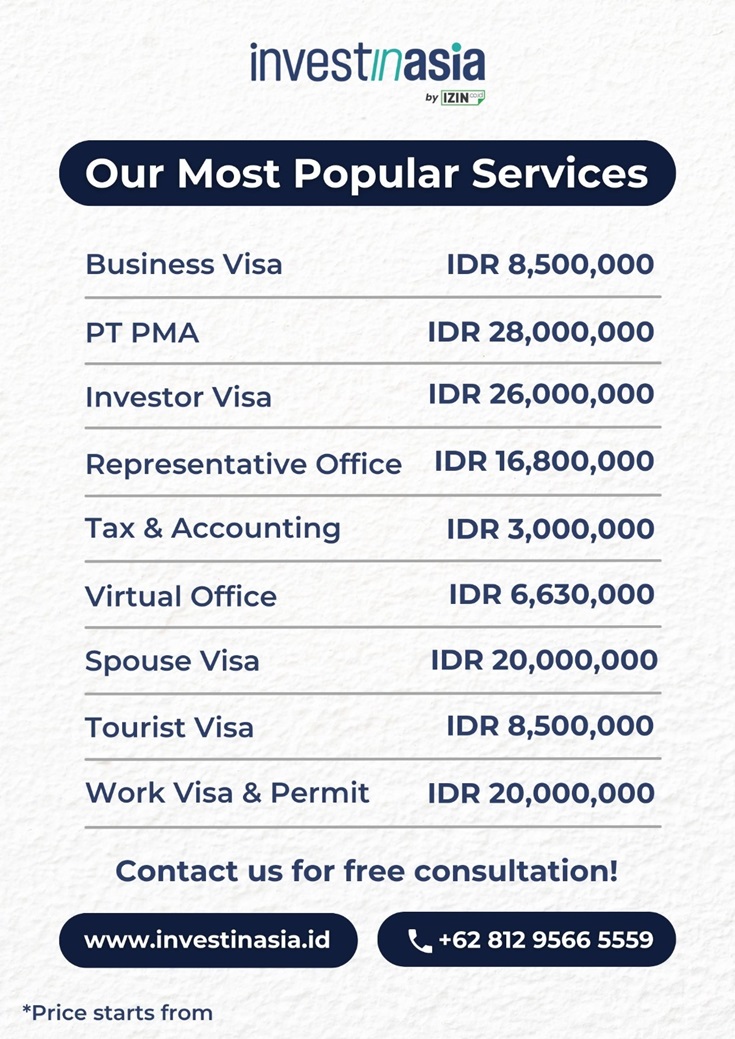
InvestinAsia is among the companies that specialize in aiding you to setting up a company in Indonesia. We boast a team of seasoned experts who can guide you throughout the process of:
- PMA / foreign company registration in Indonesia
- Indonesia representative office setup
- Virtual office rent in Indonesia
- Business registration number in Indonesia
In addition to that, we can also assist you with the Indonesia Investor Visa / KITAS Application.
So, if you are interested in starting an investment journey in Indonesia, you can start by contacting us for FREE consultation.
Setting up a PT PMA in 2026 means working across several government bodies. A licensed Indonesian notary handles the deed of establishment. The Ministry of Law and Human Rights (AHU) registers the legal entity. OSS-RBA issues the NIB and sector licenses. After incorporation, the company must comply with the paid-up capital and total investment value requirements, observe the 12-month lock-up, file LKPM reports on the updated schedule, and keep KBLI codes aligned with actual business activities.
For foreign founders who want to avoid the delays and rework that come from navigating this alone, InvestinAsia’s PT PMA registration service covers the end-to-end process: notarial deed, AHU registration, KBLI analysis, OSS-RBA NIB issuance, bank account coordination, and post-incorporation compliance setup. For sector-specific permits required after NIB, InvestinAsia’s business license application service handles the follow-on applications.
Ready to Register Your PT PMA but Not Sure Where to Start?
InvestinAsia’s 380+ in-house professionals manage every step, from KBLI selection and capital structuring to OSS filing and LKPM compliance.