
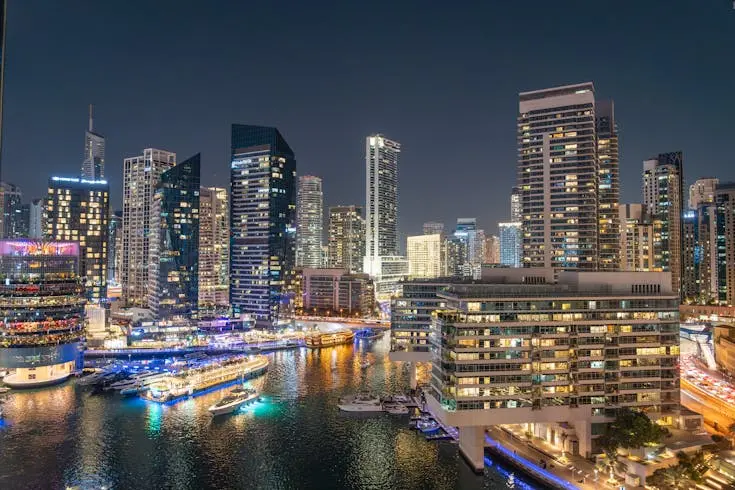
Dubai has genuinely opened up for foreign business owners over the past few years. The UAE amended its Commercial Companies Law in 2021, and the D33 Economic Agenda launched in 2023 took things further, removing the local partner requirement from most mainland business activities. Today, foreigners can own 100% of a company in Dubai without needing an Emirati sponsor, on the mainland and in free zones alike. The city recorded AED 355 billion in GDP across the first nine months of 2025, up 4.7% year-on-year. Several sectors are drawing particularly strong interest from foreign investors right now.
Why Dubai Is Attracting More Foreign Investors Than Ever
The D33 Economic Agenda was initiated by Sheikh Mohammed bin Rashid Al Maktoum in 2023. It is a ten-year plan to double Dubai’s economy by 2033 and position the emirate among the world’s top three cities for business and investment. The plan targets AED 32 trillion in cumulative economic activity and aims to raise foreign direct investment to over AED 60 billion annually.
What has changed on the ground for foreign investors:
- 100% foreign ownership: Foreigners can fully own a mainland company in most business activities. The Department of Economy and Tourism (DET) maintains a restricted activities list, but it covers only a narrow range of sectors.
- Low tax environment: There is no personal income tax in the UAE. Corporate tax is capped at 9% on profits above AED 375,000, and qualifying businesses in free zones may be exempt on eligible income.
- Free zones: Dubai has over 45 free zones, each aligned to specific industries. They offer full foreign ownership, faster licensing, and in most cases 0% import/export duties.
- Strategic location: Dubai sits within a four-hour flight of markets covering roughly 3 billion consumers across Asia, Africa, and Europe.
- Profit repatriation: There are no restrictions on transferring profits and capital out of the UAE.
The Most Promising Business Sectors in Dubai for Foreigners
Not every sector is at the same stage of growth or has the same entry requirements. The sectors below combine strong demand, clear foreign investment access, and regulatory clarity as of 2026.
1. E-Commerce and Digital Retail
The UAE e-commerce market reached approximately AED 32.3 billion (USD 8.8 billion) in 2024 and is projected to exceed AED 50.6 billion (USD 13.8 billion) by 2029. High smartphone penetration and strong logistics infrastructure are the main drivers. Dubai issued 1,969 business licences for e-commerce platform development and management in a single year.
Foreign entrepreneurs can set up e-commerce businesses through free zones such as Dubai CommerCity, built specifically for digital trade, or through a mainland licence from the DET. The large platforms like Amazon.ae and Noon dominate mass categories, but niche verticals, such as sustainable goods, modest fashion, specialty food imports, and premium consumer brands, still have real room.
2. Fintech and Financial Services
Dubai’s fintech sector was valued at USD 3.16 billion in 2024 and is expected to reach USD 5.71 billion by 2029 at a CAGR of around 12.56%. The Dubai International Financial Centre (DIFC) houses over 800 fintech and innovation firms, and new company registrations there grew 32% in the first half of 2025.
The DIFC operates under English common law, which removes one layer of unfamiliarity for foreign investors used to common law jurisdictions. Payment processing, digital wallets, RegTech, and open banking infrastructure all show strong demand. DIFC’s AI License supports companies in artificial intelligence, machine learning, and data science, with setup costs starting from around USD 9,623.
3. Healthcare and Medical Services
Dubai’s healthcare sector grew 26% in Q1 2025, reaching AED 16 billion and accounting for 13.4% of the emirate’s total economy. The number of licensed healthcare facilities stands at approximately 5,800, with the private sector workforce exceeding 69,400 professionals.
Specialty clinics (dermatology, dental, fertility, orthopaedics), telemedicine platforms, medical tourism services, and health technology applications are where most foreign investor activity is concentrated. Healthcare businesses require licensing from either the Dubai Health Authority (DHA) for mainland operations or the Dubai Healthcare City Authority (DHCCA) for the dedicated free zone. Medical professionals must complete DHA credential validation through the Sheryan Portal before practising.
4. Real Estate and PropTech
Dubai’s property market continues to attract strong foreign capital. The liberalisation of freehold ownership for non-nationals in designated areas has widened the opportunity beyond pure property purchase. For foreign business owners, the stronger plays tend to be in property management services, short-term rental companies, co-working space operators, commercial leasing, and PropTech platforms. Warehousing and cold storage are also in consistent demand, pulled along by logistics sector growth.
Property management services can be started with a modest investment. Licensing and initial operations typically run AED 50,000 to AED 150,000 based on industry benchmarks. PropTech platforms require more upfront capital, but return potential is significant once a client base takes hold.
5. Tourism and Hospitality
Dubai welcomed 18.72 million international visitors in 2023, and the number has kept climbing. Tourism and hospitality consistently rank among the top recipients of foreign direct investment, with active capital flowing into hotel development, luxury resorts, wellness retreats, and experience-based travel. Expo City Dubai and the government’s broader cultural project pipeline continue extending the city’s international draw.
Foreign entrepreneurs find traction in boutique hotel operations, guided adventure and cultural tourism, eco-tourism, and hospitality technology platforms. The DET issues mainstream hospitality licences for mainland operations, and tourism-specific licences are available through the Dubai Department of Tourism and Commerce Marketing (DTCM).
6. Logistics and International Trade
The UAE’s logistics sector was valued at USD 54.5 billion in a recent industry assessment. Dubai sits between Jebel Ali Port, the ninth-largest container port in the world, and Dubai International Airport, one of the busiest cargo airports globally. That geography is a real operating advantage for freight and trading businesses.
Foreign investors in import/export, freight forwarding, customs clearance, and supply chain management tend to anchor in Jebel Ali Free Zone (JAFZA), which has the most purpose-built infrastructure for goods movement. The UAE’s non-oil foreign trade hit a record AED 3.5 trillion in 2023. Companies handling goods through free zones also access duty-free import and re-export channels.
7. Technology, AI, and Digital Innovation
Dubai has a national AI strategy that runs across public services and commercial sectors. Technology is expected to claim a growing share of the emirate’s GDP through 2026 and beyond, with the most active growth in AI, cloud computing, cybersecurity, gaming, and Web3. Dubai Internet City (DIC) hosts the Middle East headquarters of Google, Microsoft, and LinkedIn, which matters for smaller tech firms trying to build regional credibility and tap talent. Dubai Silicon Oasis serves tech manufacturing and R&D. DMCC runs the gaming and cryptocurrency ecosystem. The UAE video games market alone is projected to reach USD 492.90 million by 2027, with over 90% of UAE adults regularly playing games.
8. Renewable Energy and Green Business
The UAE has committed to ambitious sustainability targets, and Dubai actively supports green startups through grants, mentorship, and accelerator programs. The clearest business opportunities are in solar energy, electric vehicle infrastructure, green packaging, sustainable construction materials, and environmental consultancy. Masdar City Free Zone in Abu Dhabi is the most specialized zone for renewable energy firms. Broader sustainable business activities can also be licensed across Dubai free zones.
Not Sure Which Sector or Free Zone Fits Your Business Plan?
InvestinAsia’s Dubai team handles sector matching, licensing, and bank account opening end-to-end.
Free Zone vs. Mainland: Which Setup Fits Your Business Sector?
The choice between a free zone and a mainland company comes down to where you plan to sell and who your customers are. Both options allow 100% foreign ownership, but they differ significantly on market access, tax treatment, and regulatory structure.
| Factor | Free Zone | Mainland (DET) |
|---|---|---|
| Foreign ownership | 100% | 100% in most activities |
| UAE mainland market access | Via local distributor or new branch permit | Direct, unrestricted |
| Corporate tax | 0% on qualifying income; 9% on non-qualifying | 9% on profits above AED 375,000 |
| Import/export duties | Typically 0% within the zone | Standard customs duties apply |
| Setup speed | 3 to 10 working days; some zones offer 24 to 48 hours | 5 to 15 working days |
| Best for | International trade, services, technology, fintech, e-commerce targeting global markets | Businesses selling directly to UAE consumers or government entities |
Executive Council Resolution No. 11 of 2025 expanded access for free zone companies to serve mainland customers under certain conditions. That has narrowed the gap between the two structures. That said, businesses that depend heavily on UAE retail or government contracts generally still benefit from a mainland licence.
For foreign investors deciding which structure fits and which free zone authority matches their activity, InvestinAsia’s Dubai company registration service covers both free zone and mainland setups, with a local team on the ground in Dubai.
Other Structural Advantages Worth Knowing
A few broader conditions make Dubai stand out compared to other international expansion destinations right now.
Golden Visa Eligibility
Investors and entrepreneurs can qualify for the UAE Golden Visa, a ten-year self-sponsored residency permit. Qualifying criteria include investing in a free zone company above a specified threshold or meeting salary and professional benchmarks. It removes the annual renewal cycle that comes with standard UAE residency.
No Restrictions on Profit Repatriation
Foreign business owners can transfer 100% of profits and invested capital out of the UAE. There are no withholding taxes on dividends or capital gains for most business structures.
An Expatriate-Majority Workforce
Approximately 90% of Dubai’s population are expatriates. This gives businesses access to a diverse, English-proficient talent pool from across Asia, Africa, Europe, and the Americas. The language and cultural barriers that typically slow down international expansion are lower here than in most markets.
Airport and Port Access
Dubai International Airport and Jebel Ali Port together connect the emirate to over 100 global destinations. For businesses that depend on physical goods movement or frequent international travel, that infrastructure matters day to day.
How to Start Your Business in Dubai as a Foreigner
Company registration in Dubai follows a defined process, though specific requirements vary by free zone authority and business activity. Here is the general sequence:
Step 1: Choose Your Business Activity and Structure
Your business activity determines the licence type you need (commercial, professional, industrial, or e-commerce) and which free zones can host your company. Getting the activity classification wrong at this stage causes delays and can trigger additional government approvals.
Step 2: Select Your Jurisdiction
Choose between a free zone company (FZE for a sole shareholder, FZC or FZ-LLC for multiple shareholders) or a mainland company registered through the DET. The right answer depends on your target market, tax position, and how much of your revenue will come from within the UAE.
Step 3: Reserve a Trade Name and Submit Documentation
UAE naming rules require a unique name that complies with local conventions and avoids restricted terms. Standard documents include passport copies of all shareholders, a business plan, and in some cases a board resolution when a corporate entity is a shareholder.
Step 4: Receive Your Licence and Arrange a Physical Address
All Dubai businesses need a registered address. Free zones offer flexi-desks, serviced offices, and warehouse space depending on the activity. Licence processing takes between 24 hours and 15 working days depending on the zone and activity type.
Step 5: Open a Corporate Bank Account and Apply for Visas
UAE banks conduct thorough due diligence before approving corporate accounts. Timelines run from one to two weeks with established banks, faster with some regional institutions. Investor and employee visas are processed through the free zone authority or the General Directorate of Residency and Foreigners Affairs (GDRFA).
InvestinAsia’s Dubai team assists with airport pickup, medical checks, biometrics, and bank account introductions as part of the company registration process. For anyone setting up in Dubai for the first time, having local support at each step reduces the risk of procedural delays considerably. You can also read InvestinAsia’s complete guide to starting a business in a Dubai free zone for more detail on the process.
Ready to Enter the Dubai Market?
With 380+ professionals and a local Dubai team, InvestinAsia gets your company registered and operational fast.
Frequently Asked Questions
Can a foreigner own 100% of a business in Dubai?
Yes. Following amendments to the UAE Commercial Companies Law, foreigners can own 100% of a mainland business in most activities without a local partner. Free zones have always permitted full foreign ownership. The Department of Economy and Tourism (DET) maintains a restricted activities list for mainland companies, but the vast majority of commercial and professional activities are not on it.
What are the most profitable business sectors in Dubai for foreigners?
Based on current market data, fintech, healthcare, e-commerce, logistics, and technology (AI, gaming, cloud services) show the strongest growth and foreign investment activity in 2025 to 2026. Which sector makes sense depends on your background, available capital, and intended customer base.
What is the difference between a free zone and a mainland company in Dubai?
Both allow 100% foreign ownership. Free zone companies can benefit from 0% corporate tax on qualifying income and simpler setup, but they traditionally could not sell directly to UAE mainland customers. Mainland companies registered through the DET have full access to the UAE domestic market but pay the standard corporate tax. Executive Council Resolution No. 11 of 2025 has partially eased this restriction for free zone firms.
Do foreign companies pay corporate tax in Dubai?
The UAE introduced a 9% corporate tax in 2023, applicable to profits above AED 375,000. Free zone companies with qualifying income may be exempt under the Qualified Free Zone Person (QFZP) framework, provided they meet certain substance requirements. Personal income tax does not exist in the UAE.
How long does it take to register a company in Dubai?
Free zone company registration typically takes 3 to 10 working days. Some free zones, such as Dubai South and Meydan Free Zone, offer digital processing in 24 to 48 hours for eligible activities. Mainland registration through the DET generally takes 5 to 15 working days. Corporate bank account opening adds one to two weeks in most cases.
Which free zone in Dubai is best for my business sector?
The answer depends on your industry. DMCC is the top choice for commodity trading, gold, precious metals, and cryptocurrency. DIFC suits financial services and fintech. Dubai Internet City serves tech and IT companies. Jebel Ali Free Zone (JAFZA) is the standard for logistics and manufacturing. Dubai Healthcare City is for medical and wellness businesses. Dubai CommerCity focuses on e-commerce and digital trade.
References
1. Dubai Media Office. (2025). Dubai GDP grows 4.7% year-on-year to AED 355 billion. Retrieved from
https://mediaoffice.ae/news/2025/
2. Invest in Dubai. (2023). Dubai Economic Agenda D33. Government of Dubai. Retrieved from
https://www.investindubai.gov.ae/en/why-dubai/d33-agenda
3. UAE Government Portal. (2024). Starting a business in a free zone. Retrieved from
https://u.ae/en/information-and-services/business/doing-business-in-free-zones/starting-a-business-in-a-free-zone
4. UAE Ministry of Economy and Tourism. (2024). Establishing businesses. Retrieved from
https://www.moet.gov.ae/en/establishing-companies
5. Dubai Development Authority. (2024). Setting up a Free Zone LLC. Retrieved from
https://dda.gov.ae/en/registration-licensing/setting-up-a-business/free-zone-limited-liability-company
6. DMCC. (2025). Top business opportunities in Dubai. Retrieved from
https://dmcc.ae/blog/top-business-opportunities-in-dubai
7. Invest in Dubai. (2024). Foreign ownership restrictions list. Department of Economy and Tourism. Retrieved from
https://www.investindubai.gov.ae/en/business-setup/mainland-companies/foreign-ownership-restrictions-list