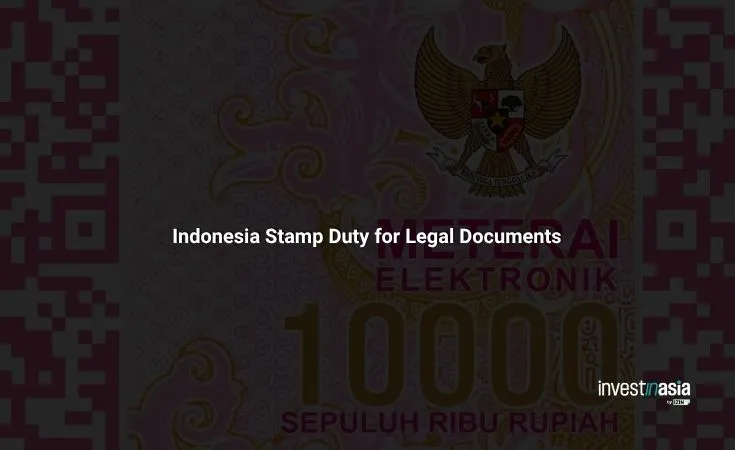
Indonesia charges stamp duty, or Bea Meterai, at IDR 10,000 once for each qualifying document.
The tax can apply to paper or electronic records, including agreements, notarial deeds, certain money documents, and documents used as evidence in court.
The IDR 5 million threshold does not apply to every contract. It applies to the category of documents that state receipt of money or acknowledge that a debt has been settled or calculated.
Key Takeaways
- Law No. 10 of 2020 sets one IDR 10,000 charge for each document subject to stamp duty.
- Agreements can attract stamp duty regardless of contract value; the IDR 5 million threshold applies to specified money receipt and debt acknowledgment documents.
- Documents made outside Indonesia become chargeable when they are used in Indonesia, while electronic documents can use an electronic stamp.
- An unpaid or underpaid duty may require postdated duty stamping and, for documents chargeable from 1 January 2021, a 100% administrative penalty on the unpaid duty.
Stamp Duty Is a Tax on Specific Documents
Law No. 10 of 2020 defines stamp duty as a tax on documents. It applies once to each document that falls within the statutory categories, rather than to every page or every business record.
The Directorate General of Taxes includes handwritten, printed, and electronic records in the document definition when they can be used as evidence or information.
As of October 2026, Law No. 10 of 2020 remains the main Stamp Duty Law. Ministry of Finance Regulation No. 78 of 2024 governs implementation and replaced three ministerial regulations issued in 2021.
Law No. 1 of 2026 later adjusted criminal provisions in the Stamp Duty Law. It did not alter the IDR 10,000 rate in Article 5 or the document categories in Article 3.
A duty stamp proves payment of the document tax. It does not replace a review of signing authority, consent, the contract terms, or any formality required for the underlying transaction.
Documents That Are Subject to Stamp Duty
The Stamp Duty Law lists several document groups. A company should classify the document before deciding whether to affix a physical stamp, apply an electronic stamp, or use another permitted payment route.
Agreements, Certificates, and Statements
Agreements, certificates, statements, and similar letters fall within the civil document category, together with their counterparts. The law does not make the IDR 5 million threshold a condition for agreements.
Each signed counterpart needs separate attention because duty applies once to each qualifying document. A business should record how many originals or counterparts each party receives.
Notarial and Land Deed Officer Documents
Notarial deeds are covered together with their grosse, copies, and excerpts. Deeds prepared by a Land Deed Official, known as a PPAT, are also covered with their copies and excerpts.
The duty becomes payable when these documents are signed. The notarial or PPAT process may involve other fees and legal requirements that remain separate from stamp duty.
Securities and Transaction Documents
Securities and securities transaction documents fall within the statutory list. The latter group includes futures contract transaction documents, regardless of the name or form used.
Stamp duty becomes payable when these documents are completed. The issuer owes the duty on securities. Liability for a transaction document depends on whether one party or several parties made it.
Auction Documents
Auction records can include excerpts, minutes, copies, and grosse of auction reports. Duty becomes payable when the document is delivered to the party for whom it was prepared.
Money Receipt and Debt Acknowledgment Documents
A document stating more than IDR 5 million is covered when it records receipt of money or acknowledges that a debt has been paid, settled, or calculated in whole or in part.
The wording and function of the record matter. An invoice that requests payment is not the same as a receipt confirming payment, so companies should avoid classifying every invoice by value alone.
Documents Used as Evidence in Court
A document used as evidence in court attracts stamp duty when it is submitted. This rule can reach a record that was outside the duty when it was first created.
Notes from InvestinAsia Consultants
Classify the document by its legal function, not its filename. A file labeled “invoice” may request payment, confirm receipt, record a settlement, or combine those functions, and each version needs its own review.
Common Documents Outside the Stamp Duty Scope
Law No. 10 of 2020 also identifies documents that do not attract stamp duty. Common business examples include transport and goods movement records, salary receipts, internal receipts, and specified public revenue documents.
The statutory list includes bills of lading, passenger and goods transport documents, proof of delivery and receipt of goods, and documents for sending goods for sale at the sender’s expense.
Salary, pension, allowance, and other employment payment receipts are outside the scope. Tax payment receipts from designated state, regional, banking, and other institutions also fall within the exclusion.
Internal money receipts, specified bank deposit records, letters of pledge, securities income distribution records, and documents issued by Bank Indonesia for monetary policy are also listed.
An exclusion depends on the document’s function and the facts. A payment record issued to an external customer does not become an internal receipt because the accounting team stores it in an internal system.
When Stamp Duty Becomes Payable and Who Pays
The payment trigger depends on the document type. The liable party also changes with the way the document was created and used.
| Document Situation | Payment Trigger | Party Liable |
|---|---|---|
| Agreement, notarial deed, or PPAT deed | When the document is signed | Each party on the document it receives, subject to an agreement on who pays |
| Document made by one party | When delivered to the intended recipient, where that trigger applies | The recipient |
| Security | When completed | The issuer |
| Document submitted as court evidence | When submitted to court | The party submitting it |
| Qualifying document made outside Indonesia | When used in Indonesia | The party receiving the benefit in Indonesia |
The parties may agree who bears the payment. That commercial allocation does not remove the underlying tax obligation or change the statutory trigger.
Unsure Which Document Rule Applies to Your Company?
Map document duties alongside your wider tax controls with support from 380+ specialists across the group.
Foreign Contracts and Electronic Documents
A qualifying document made outside Indonesia becomes chargeable when it is used in Indonesia. The party receiving the benefit from its Indonesian use owes the duty, unless the parties arrange the payment between themselves.
The explanation to Law No. 10 of 2020 gives practical examples. A foreign loan agreement is used in Indonesia when it supports debt collection, accounting records, or an Indonesian filing.
Electronic documents are within the definition of a document. Ministry of Finance Regulation No. 78 of 2024 permits payment through an electronic stamp applied through the official Electronic Stamp System.
The regulation requires an electronic stamp to carry a unique code and prescribed information. The government assigns Perum Peruri to produce and distribute electronic stamps through the regulated system.
A scan of a physical stamp pasted into a PDF does not follow that electronic stamping process. Companies should keep the stamped final file and its verification data together with the signed record.
How Postdated Duty Stamping Works
Postdated duty stamping, known as Pemeteraian Kemudian, addresses two situations: duty that was not paid or was underpaid, and documents later submitted as court evidence.
Under Ministry of Finance Regulation No. 78 of 2024, a document chargeable from 1 January 2021 with unpaid or underpaid duty requires the outstanding duty plus a 100% administrative penalty.
A document that becomes chargeable because it is used as court evidence follows a different calculation.
The party pays duty at the rate in force when postdated stamping occurs, without the separate 100% amount stated for an earlier unpaid obligation.
The payment can use a physical stamp, an electronic stamp, or a Tax Payment Slip. A Post Office official or Directorate General of Taxes official validates the postdated stamping under the procedure in the regulation.
Notes from InvestinAsia Consultants
Record the document type, trigger date, recipient, counterparts, payment method, and proof of stamping. This register gives reviewers more context than a folder of stamped files.
Build a Document Control Process
Assign an owner to classify each document before signing or delivery. The finance, legal, procurement, and corporate secretarial teams should use the same rules.
- Identify the document’s legal function and whether it appears in the statutory object or exclusion list.
- Record whether the document is paper, electronic, created outside Indonesia, or intended for court use.
- Set the payment trigger and liable party before signing, completion, delivery, or Indonesian use.
- Count the originals and counterparts that each party will receive.
- Use the permitted payment method and retain evidence that the stamp or payment was valid.
- Escalate missed or uncertain cases before relying on the document in an audit, dispute, filing, or court proceeding.
Stamp duty is one part of a company’s tax control framework. InvestinAsia’s guide to PT PMA tax obligations in Indonesia places it beside corporate income tax, withholding, VAT, and reporting duties.
Companies that need recurring bookkeeping and filing support can review InvestinAsia’s Indonesia tax compliance services.
Confirm whether document classification and stamp duty review fall within the agreed scope before relying on the service for a specific transaction.
Need a Clearer Tax Control Process?
InvestinAsia helps foreign owned companies define a practical compliance scope for Indonesian operations.
- Government of Indonesia. (2020). Law No. 10 of 2020 on Stamp Duty. Retrieved from
https://peraturan.bpk.go.id/Details/149748/uu-no-10-tahun-2020 - Ministry of Finance of the Republic of Indonesia. (2024). Ministry of Finance Regulation No. 78 of 2024 on Stamp Duty Implementation Provisions. Retrieved from
https://pajak.go.id/id/peraturan/ketentuan-pelaksanaan-bea-meterai - Directorate General of Taxes. (n.d.). Stamp Duty. Retrieved from
https://www.pajak.go.id/en/stamp-duty - Directorate General of Taxes. (2024, November 6). The Government Simplifies Stamp Duty Rules. Retrieved from
https://www.pajak.go.id/sites/default/files/2024-11/SP-36%20PEMERINTAH%20SEDERHANAKAN%20ATURAN%20BEA%20METERAI.pdf - Government of Indonesia. (2026). Law No. 1 of 2026 on Criminal Adjustment. Retrieved from
https://peraturan.bpk.go.id/Details/337869/uu-no-1-tahun-2026