
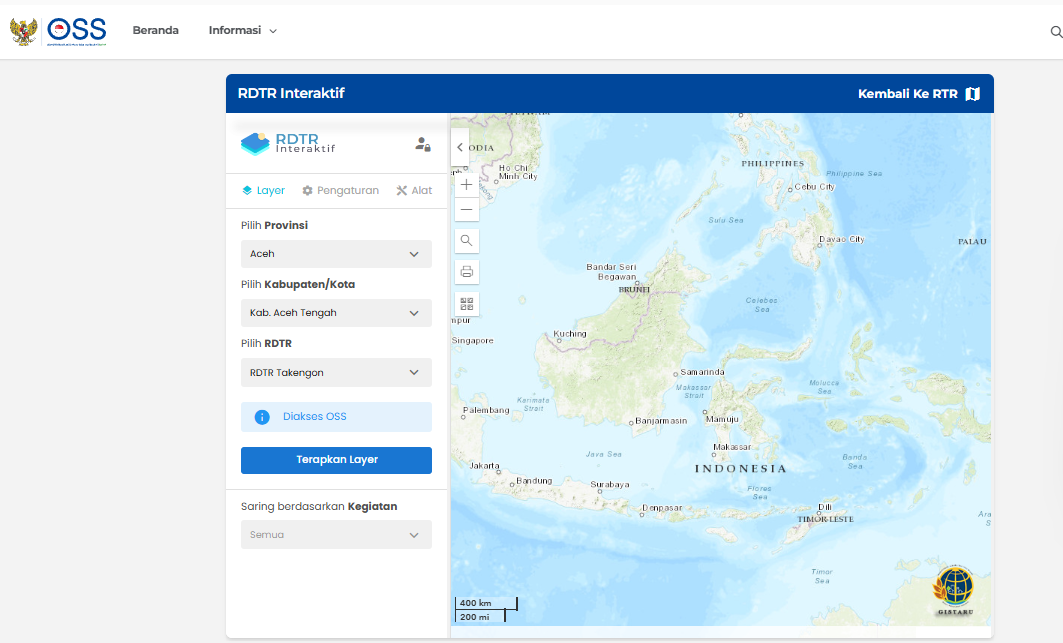
RDTR, or Rencana Detail Tata Ruang, is the government’s detailed spatial zoning plan that determines what type of business activity is allowed at a specific location. With the enforcement of Government Regulation No. 28 of 2025, RDTR is now fully embedded into the OSS system, making zoning compliance non-negotiable. The bottom line is clear. Starting in 2026, you cannot legally register or license a business in Indonesia without complying with RDTR.
For foreign investors and new businesses, this change fundamentally alters how company registration and licensing work in Indonesia. OSS no longer treats location as an administrative formality. It validates it automatically against RDTR data.
RDTR and OSS: How the System Works Now
OSS now performs real-time location validation. When you input an address or geographic coordinates, the system checks whether that point or polygon falls within a zoning area that permits your selected KBLI business activity. If the zoning does not match, the system stops.
As of December 15, 2025, 539 RDTRs across Indonesia have been fully integrated into OSS, with steady expansion expected. This means most strategic business areas are already governed by strict zoning logic enforced digitally.
Also read: Challenges in Completing OSS for Foreign Investors
Why RDTR Compliance Matters for Business Owners
RDTR is no longer a planning document. It is a licensing gatekeeper. If your business activity does not align with the RDTR zoning, OSS can request a location change, reject your application, or halt the issuance of your NIB entirely.
For foreign investors, this creates a new layer of risk. Choosing the wrong address can delay market entry by months, even if your corporate documents are otherwise complete.
Risks of Ignoring RDTR in 2026
Ignoring RDTR is not just a technical mistake. It has direct financial and operational consequences. Land purchase or lease costs may be wasted. Construction timelines can stall. Licensing submissions may need to be restarted from zero. In some cases, business operations are delayed for months due to repeated revisions.
From our experience, most failures occur not because the business model is invalid, but because the zoning analysis was skipped or misunderstood.
Also read: Risk-Based Business Licensing and OSS System in Indonesia
RDTR, KKPR, and KBLI: A Critical Triangle
RDTR determines whether a KKPR can be issued. KKPR is the spatial conformity approval required before certain licenses can proceed. KBLI selection must match both the business activity and the zoning classification under RDTR. If one element is misaligned, the entire OSS process collapses.
This is where many foreign business owners struggle, especially when regulations are updated faster than public guidance.
How We Help You Stay Compliant
At InvestinAsia, we guide you through Indonesia’s evolving regulatory landscape from the start. We begin with RDTR zoning checks, map your KBLI correctly, prepare and submit KKPR where required, and ensure your NIB is issued smoothly through OSS.
Our role is to reduce uncertainty. We help you avoid zoning rejection, minimize revisions, and keep your business timeline predictable, even as regulations continue to evolve.
If you plan to register a company or apply for business licenses in Indonesia, working with a consultant who understands RDTR is no longer optional. It is a strategic necessity.
Contact us now for FREE consultation!
Frequently Asked Questions
What is RDTR in Indonesia?
RDTR is a detailed spatial planning document that defines permitted land use and business activities by zone.
Is RDTR mandatory for business licensing in 2026?
Yes. OSS now enforces RDTR compliance automatically for licensing and NIB issuance.
What happens if my business location does not match RDTR zoning?
OSS may reject your application, request relocation, or stop the licensing process.
Does RDTR affect foreign-owned companies (PT PMA)?
Yes. RDTR applies equally to domestic and foreign-owned companies.
How can I check RDTR zoning before registering a business?
Zoning checks can be done through OSS-integrated RDTR data, usually with professional assistance to avoid misinterpretation.