Relocating a foreign company to Indonesia is the legal process of transferring or establishing full commercial operations under Indonesia’s foreign investment framework, primarily through a PT PMA (Foreign-Owned Limited Liability Company). Indonesia offers a regulated and scalable relocation environment supported by the OSS licensing system, reformed BKPM investment rules, and clearer foreign ownership permissions across key sectors. As of 2026, reduced paid-up capital requirements and simplified approvals enable foreign companies to operate directly in Southeast Asia’s largest economy with contractual authority, local hiring rights, and long-term regulatory certainty. This structured relocation pathway allows global businesses to replace indirect market entry with a compliant Indonesian operating entity built for sustained growth.
At InvestinAsia, we guide you through this process so you can relocate with legal certainty, operational clarity, and long-term compliance.
Why Foreign Companies Are Relocating to Indonesia

Indonesia offers scale, demographics, and regulatory momentum. With over 270 million people and strong government support for foreign direct investment, relocating your business allows you to operate directly in-market rather than relying on distributors or third parties. This shift gives you contractual authority, local hiring capability, and stronger control over revenue generation.
However, relocation is not a physical move alone. It is a legal transformation. Your foreign company must establish a compliant Indonesian presence under Indonesia’s foreign investment framework.
Also read: Indonesia: A Promising Destination for Company Expansion and Relocation
Choosing the Right Legal Structure
The first and most critical decision is selecting the correct business structure.
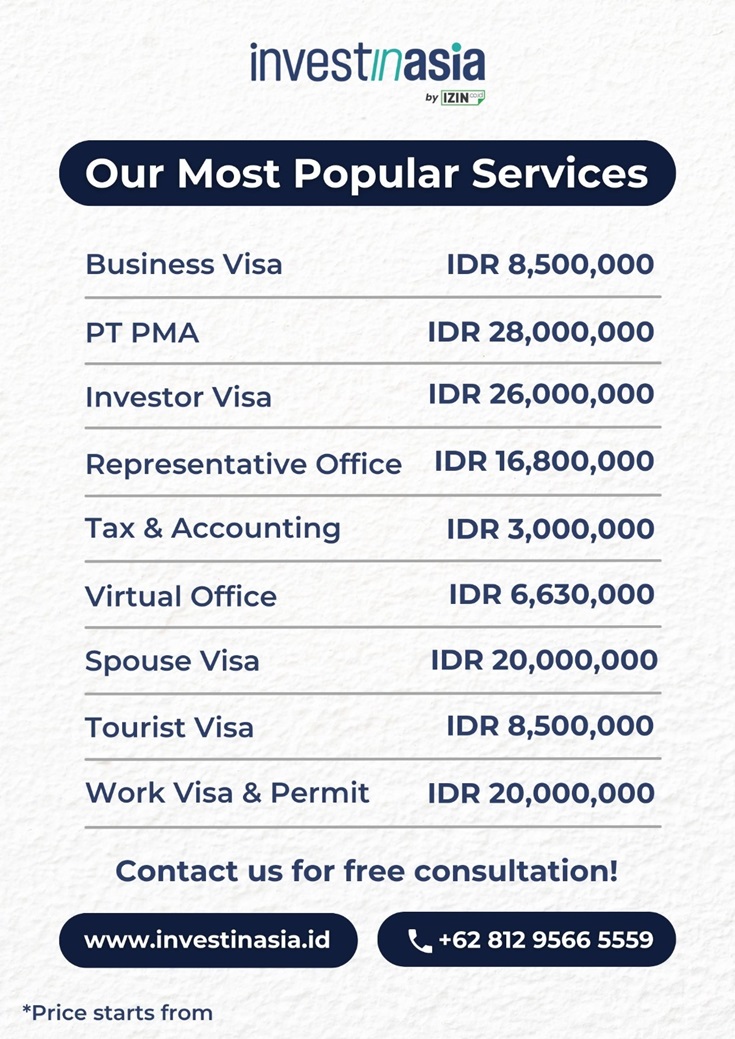
PT PMA (Foreign-Owned Limited Liability Company)
PT PMA is the only structure that allows full commercial operations. It enables you to generate revenue, sign contracts in your company’s name, hire staff, sponsor foreign work permits, and operate indefinitely. Foreign ownership can reach 100 percent unless restricted by sector regulations.
Representative Office (KPPA)
KPPA is designed for market research and liaison activities only. It cannot generate income or issue invoices. Many companies start with a representative office and later convert to a PT PMA once market validation is complete.
If your objective is full relocation rather than exploration, PT PMA is the appropriate vehicle.
Capital Requirements After the 2025 Reform
One of the biggest changes affecting relocation is the reduction of minimum paid-up capital.
Under BKPM Regulation No. 5 of 2025, a PT PMA now requires IDR 2.5 billion in paid-up capital. This capital is deposited into a local bank account and can be used for legitimate operational expenses. Your company must also declare a total investment plan of IDR 10 billion, which represents long-term commitment rather than immediate cash.
This reform significantly lowers entry barriers while maintaining Indonesia’s investment credibility.
Also read; The Minimum Capital for Establishing PT PMA Company in Indonesia
Sector Eligibility and Foreign Ownership Rules
Indonesia uses a Positive Investment List to regulate foreign ownership. Many strategic sectors such as digital services, manufacturing, healthcare, energy, and infrastructure are fully open to foreign investors. Some sectors impose ownership caps, while others remain closed.
Before relocating, your business activities must be mapped precisely to the correct KBLI codes. Misclassification can delay licensing or invalidate approvals. This step is often underestimated but critical for a smooth relocation.
Also read: Can a Foreigner Own 100% of a Business in Indonesia?
Licensing and Company Formation Process
Relocation follows a clear sequence:
- Preparation of Articles of Association and Deed of Establishment with an Indonesian notary
- Obtaining legal entity authorization from the Ministry of Law and Human Rights
- Establishing a corporate bank account and funding the required paid-up capital
- Registration through the OSS system to obtain NIB and business licenses
- Tax registration and NPWP issuance
- Sector-specific permits, if applicable
Each stage builds on the previous one. Missing or incorrect documentation can cascade into delays across multiple agencies.
This is the stage where we typically support clients through InvestinAsia’s PT PMA company registration services, ensuring your structure, capital, and licenses align from day one.
Also read: Step-by-Step Guide to Register Your PT PMA in Indonesia 100% Remotely with InvestinAsia
Immigration and Workforce Readiness
Relocating your company often means relocating people. Foreign directors, commissioners, or technical experts require RPTKA approval, work permits, and KITAS. Indonesia applies strict role-based justifications for foreign workers, so planning immigration early is essential to avoid operational gaps.
Ongoing Compliance After Relocation
Relocation does not end at incorporation. A PT PMA carries ongoing obligations including:
- Quarterly LKPM investment reports to BKPM
- Monthly and annual tax filings
- Annual shareholders meetings
- BPJS employee registrations
- Maintenance of sectoral licenses
Non-compliance can result in warnings, license suspension, or revocation. A disciplined compliance calendar is non-negotiable.
Common Challenges Foreign Companies Face
Most delays arise from document legalization, capital transfer timing, sector license complexity, or misuse of virtual offices. These issues are avoidable with proper sequencing and local expertise.
Our role is to anticipate these friction points before they impact your timeline.
Relocating a foreign company to Indonesia is a strategic decision that requires legal legitimacy, regulatory awareness, and structured execution. The regulatory reforms of 2025 have made relocation more accessible, but the process remains detailed and compliance-driven.
If you intend to relocate but do not yet have an Indonesian legal entity, InvestinAsia’s complete Indonesia company registration services and Representative Office Set Up Services in Indonesia provide end-to-end support from initial structuring to full operational readiness. We act as your local expert team so you can focus on scaling your business with confidence.
Contact us now for FREE consultation!
Frequently Asked Questions
Can a foreign company fully relocate operations to Indonesia?
Yes. By establishing a PT PMA, foreign companies can fully operate, hire staff, generate revenue, and manage operations locally.
Is paid-up capital locked and unusable?
No. Paid-up capital must be deposited but can be used for legitimate business expenses.
How long does the relocation process take?
On average, 3 to 5 months for full operational readiness, depending on sector complexity.
Can relocation start without a physical office?
A physical office is strongly recommended for commercial operations. Virtual offices have regulatory limitations.
Is Indonesia suitable for regional headquarters?
Yes. Many multinationals use Indonesia as an ASEAN operational base due to market size and talent availability.